

How to Write About Liberia
Darlington Sehgbean
October 2, 2025
If you want to write about Liberia, begin with honesty.
Don’t mention only the scars of war, the wasted chances, or the convoys that grew while classrooms shrank. Mention instead the teacher who stays after school with no pay, the entrepreneur who hires five staff, the “oldma” (elderly woman) in Redlight Market who presses roasted cassava into your hand and says, “Eat, my child, you are welcome.” These are the stitches holding the country together when politics comes undone.
Don’t mention Liberia only as a battlefield. Mention Leymah Gbowee and the women in white who prayed and fasted until their bodies weakened but their voices grew. At the 2003 Accra peace talks, when men stalled, they locked arms at the doors and refused to let anyone leave without progress. That act pushed the country toward peace. Then mention the Gbowee Peace Foundation Africa, which has since awarded more than 1,200 scholarships to young women and children.

Leymah Gbowee and Ellen Johnson Sirleaf received the Nobel Peace Prize, 2011. Image courtesy of Harry Wad is modified and licensed under CC BY-SA 3.0.
Don’t mention leadership only as betrayal. Mention Ellen Johnson Sirleaf, Africa’s first elected female head of state, who secured US$4.6 billion in debt relief, revived the Mt. Coffee Hydropower Plant, and passed West Africa’s first Freedom of Information Act. During the Ebola epidemic, she opened treatment units and steadied a frightened country. Under her watch, primary school enrollment nearly doubled, and the Liberian Anti-Corruption Commission was created. These were not small acts. And remember: both Sirleaf and Gbowee stood together in 2011 as Nobel Peace Prize laureates.
Don’t mention George Weah only as a politician. Mention Weah the footballer, 1995 Ballon d’Or winner and UNICEF Goodwill Ambassador, who built youth leagues, funded scholarships, and showed a whole generation that Liberia could shine on the global stage.
Don’t mention the tired claim that Liberian students are not serious. Mention Wantoe T. Wantoe Wontoe, admitted to Oxford while courted by Columbia, Johns Hopkins, and NYU. Mention S. Malcolm Jabateh, who studied from NYU Abu Dhabi to UC Berkeley. Mention the many other Liberian students across the United States, China, and Europe (some of whom are professionals in various fields) and those still home writing scholarship applications by candlelight.
Don’t mention only those who left. Mention the youth who stayed and built. Mention Marvin Tarawally, James Kiawoin, and Ahmed Konneh, co-founders of SMART Liberia, creating scholarship pathways and leadership programs. Mention Wainwright Acquoi, whose nonprofit TRIBE lifts high school learning and teaches entrepreneurship. Mention Mahmud Johnson, who founded J-Palm Liberia, turning palm kernels into consumer products while creating jobs for women and youth. These ventures are not anecdotes — they are blueprints for a different Liberia.
Don’t mention corruption as if it swallows the nation whole. Mention it precisely. Say that in 2022, Nathaniel McGill, Sayma Syrenius Cephus, and Bill Twehway were sanctioned by the U.S. Treasury. Say that in 2023, Jefferson Koijee was designated, and Samuel Tweah, Albert Chie, and Emmanuel Nuquay were named by the U.S. State Department. Record the names, yes. But then mention the cocoa farmer replanting his fields, the nurse working without supplies, the musician sending Liberian sound across borders. Corruption is part of Liberia’s story, but it is not its whole.
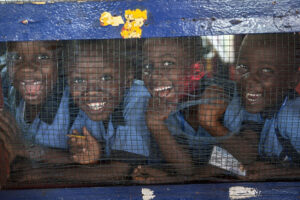
Students at the Herman Gmeiner School, Monrovia. Image courtesy of UN Photo/Staton Winter is unmodified and licensed under CC BY-NC-ND 2.0.
Don’t mention peace as if it were abstract. Mention the Accra Peace Agreement that stopped the guns. Mention the 2018 end of UNMIL, when Liberia finally stood on its own. Then show what peace looks like today: cassava leaves and palm butter on the table, roasted plantains in Redlight Market and Down Waterside, children playing soccer barefoot on Saye Town Field, Christians and Muslims trading side by side in Gobachop and Duala. Show the ordinary: a market day that ends without gunfire, a child who comes home from school, a soccer match where the loudest sound is the crowd.
Don’t mention Liberia without its culture. Mention JZyNo recording hooks that cross borders, CIC and MC Caro raising the flag abroad, Christoph The Change selling out the SKD Stadium and Takun J schooling younger rappers. In those tracks, you will hear a country that refuses silence.
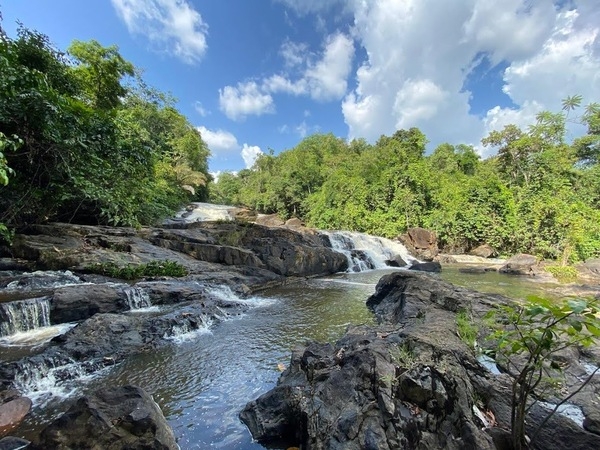
Kpatawee waterfall. Image courtesy of The World Factbook is modified and in the public domain.
Don’t mention the land only as resources. Mention Kpatawee Waterfall, the Cavalla River, Mount Nimba, Mount Wologizi, and Sapo National Park. Mention RLJ Kendeja Resort & Villas, Libassa Ecolodge, and Kokon Ecolodge, but ask who is hired, who benefits, and how tourism can serve locals too.
Don’t mention history only as ruins. Mention Providence Island, where freed Black settlers landed in 1822. Mention the Ducor Hotel, once West Africa’s pride, now a ruin and a warning.
Don’t mention Liberia as if it were one language or one story. Mention that English is our official language, but daily life is spoken in Kpelle, Bassa, Kru, Grebo, Gio, Mano, Lorma, Gola, Kissi, Vai, Mandingo, Krahn, Gbandi, Belle, and Dei. Accents shift with county lines, but welcomes do not. Someone will always say, “Sit. Eat. You are welcome.”
Close with a simple truth. Name the harm clearly. Then name the builders fully. Aim your sharpest satire at swollen convoys, not at the poor. Write Liberia as it is: scarred but striving, tired but reaching. Write it wounded, hopeful, and alive. Above all, write it true.