


Peru, Brazil, and Colombia:
1879-1912
What
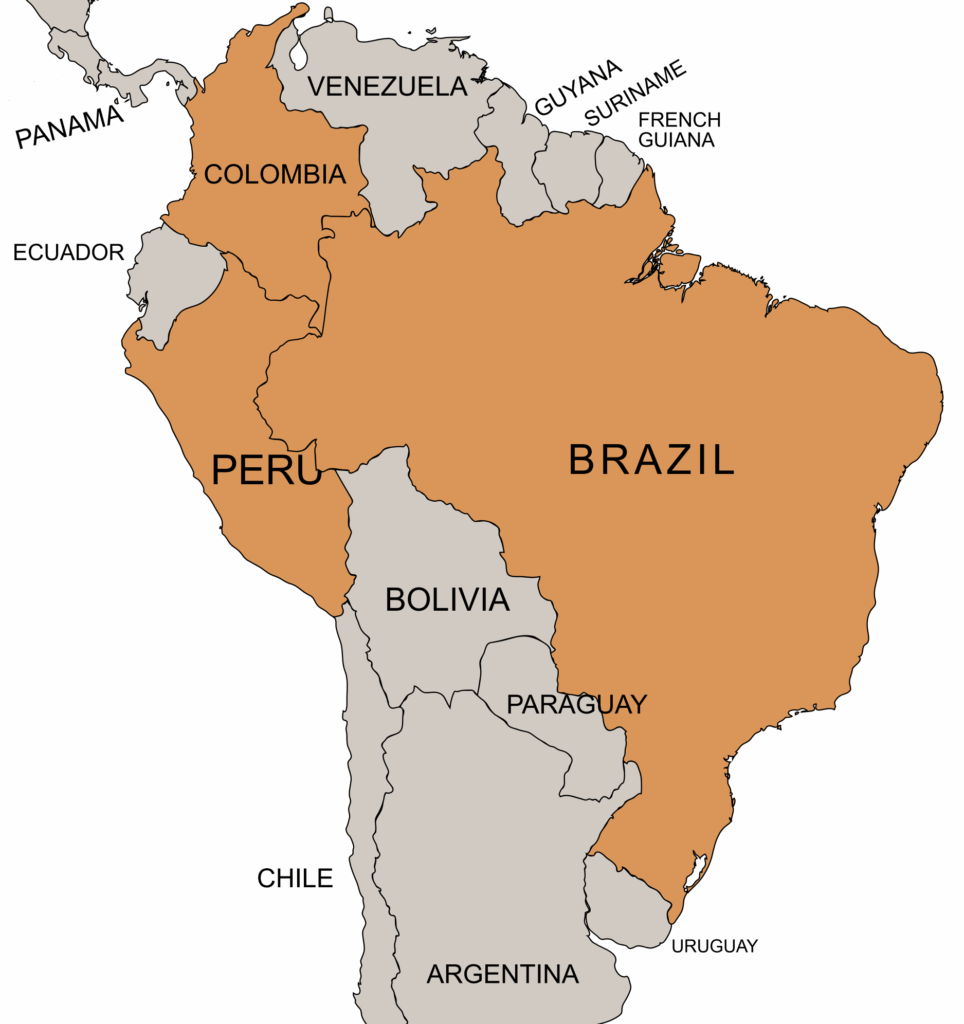
Map of South America with Peru, Brazil, and Colombia highlighted. Image created using Mapchart is licensed under CC BY-SA 4.0.
An estimated 100,000 indigenous people of South America died during the Amazon Rubber Boom between 1879 and 1912.[1] Victims of the rubber boom atrocities faced slavery, torture, rape, starvation, and execution at the hands of European rubber companies. Some estimates suggest that the Putumayo Indians lost over 90% of their population during this period.[2]
Where
This occurred in the Amazon rainforest in Peru, Brazil, and Colombia. These vast tracts of rainforest were home to hundreds of thousands of indigenous people. In this period, the rainforests were not strictly governed by South American states, and rubber companies effectively ruled large sections of land without external oversight.
When
The Amazon Rubber Boom began at around 1879 and continued into the 20th century. The rise of industrialization throughout the world required a steady flow of supplies from resource-rich areas like the Amazon. The discovery of rubber trees throughout the region prompted a number of companies to set up rubber-harvesting operations.
At the start of the rubber boom, companies typically used mestizos (people who were half Spanish and half indigenous) and other non-European workers. As time went on, rubber companies discovered that it was far cheaper to use local labor and began enslaving the nearby indigenous populations. Slaves and workers were often underfed, lived in squalor, and were regularly subjected to cruel and sadistic treatment by their captors.
How
In 1906, Roger Casement, an Irish diplomat, was sent by the British government to investigate allegations of the use of slavery as used by the Peruvian Amazon Company. Horrified by what he saw, Casement wrote extensively about the company’s human rights abuses. He found that the vast majority of the 1,600 indigenous workers he saw had been badly beaten, whipped, starved, and otherwise abused. He further reported that, in the span of twelve years, 30,000 indigenous people were killed.
Casement wrote that the men who had been assigned to whip the slaves, “had lost all sight or sense of rubber-gathering – they were simply beasts of prey who lived upon the Indians and delighted in shedding their blood.”[3]
Updated June 2025
References
[1] Gatehouse, M. (2012, October 25). The Putumayo Atrocities. Latin American Bureau. https://lab.org.uk/the-putumayo-atrocities/
[2] Juan Alvaro Echeverri, J.A. (2011, January 1). The Putumayo Indians and the Rubber Boom. Irish Journal of Anthropology, 14(1), 13-18. https://www.researchgate.net/publication/259624510_The_Putumayo_Indians_and_the_Rubber_Boom
[3] Taussig, Michael. “Culture of Terror, Space of Death. Roger Casement’s Putumayo Report.” Pg. 478