


Minnesota Constitutional Remedies Act:
Background, Legal Framework, and 2026 Legislative History
Overview
The Minnesota Constitutional Remedies Act was a 2026 proposal to create a state civil cause of action for people whose rights under the United States Constitution or the Minnesota Constitution were violated by government actors. Its most consequential feature was that it would have allowed damages claims against federal officers, a category of defendant not covered by 42 U.S.C. § 1983 and now only narrowly reachable through the federal Bivens doctrine. The proposal did not become law. Two substantially identical House-Senate bill pairs were introduced, a House version received two committee hearings but did not advance, and revised language was later included in a broader Senate omnibus bill, SF 3699. The Senate passed that bill 34-33 on May 11, 2026, but the House did not act before the Legislature adjourned sine die on May 18. A new bill would therefore be required in the 2027 Legislature.
Goal of the Legislation
The introduced legislation proposed a new Minnesota Statutes section 604.51. It stated that any person acting “under color of” federal, state, territorial, District of Columbia, or local law who deprived a Minnesota citizen or another person within Minnesota’s jurisdiction of rights, privileges, or immunities secured by the federal or state constitution would be liable to the injured person. “Under color of law” is a civil-rights term referring to conduct carried out through governmental authority, not merely private conduct.
The act would not have created new constitutional rights. Instead, it would have created a mechanism for enforcing rights that already exist. It was also broader than an immigration-specific bill: although federal immigration enforcement supplied much of the immediate political context, the proposed cause of action was written to cover any qualifying government actor and any deprivation of a protected federal or Minnesota constitutional right.
The bill provisions included:
- Who could sue: any Minnesota citizen or other person within Minnesota’s jurisdiction who suffered a covered constitutional deprivation. Citizenship was not required.
- Who could be sued: a “person” acting under color of federal, state, territorial, District of Columbia, or local law. The text was not limited to police or immigration officers.
- Available relief: damages, injunctive relief, equitable relief, or another appropriate remedy. The proposal imposed civil, not criminal, liability.
- Attorney fees: the introduced bills required an award of reasonable fees and costs to a prevailing plaintiff; the later Senate version made that award discretionary.
- Filing period: six years in the introduced standalone bills; three years in the final Senate version.
The introduced versions also contained a separate intergovernmental-collaboration requirement. A Minnesota state or local law-enforcement agency could not voluntarily enter a collaboration, task force, or partnership with a federal agency unless a written agreement required compliance with the federal and Minnesota constitutions and recognized potential liability under the new cause of action. That provision was removed during the first House hearing and was not included in the version that later passed the Senate.
Why Proponents Said the Act was Necessary
The legislation was designed to address what supporters described as a remedial gap. A constitutional right and a legal remedy are not the same thing: a person may be able to show that the government acted unconstitutionally but still lack a viable route to obtain damages from the responsible official.
1. Section 1983 covers state and local actors, not federal officers.
Federal law, 42 U.S.C. § 1983, authorizes suits against persons acting under color of state or local law who violate federal constitutional or statutory rights. It generally does not apply to officers acting under federal authority. The Minnesota proposal borrowed heavily from Section 1983’s wording, but extended a state-law remedy to federal actors and added a remedy for violations of the Minnesota Constitution.
2. Bivens damages claims against federal officers are now narrow.
In Bivens v. Six Unknown Named Agents (1971), the United States Supreme Court recognized an implied damages action against federal officers for a Fourth Amendment violation. The Court later recognized Bivens remedies in only two other settings and has repeatedly cautioned against extending the doctrine to new contexts. Ziglar v. Abbasi (2017) and Egbert v. Boule (2022) made new Bivens claims especially difficult. The result is that many alleged federal constitutional violations do not have a federal statutory damages remedy and may not fit within the few existing Bivens categories.
3. The Federal Tort Claims Act is not a general constitutional remedy.
The Federal Tort Claims Act permits certain tort suits against the United States, subject to procedural requirements and significant exceptions. It is based on state-law tort liability and does not itself create a cause of action for violating the Constitution. It can provide relief in some cases involving federal employees, but it is not a direct substitute for a constitutional damages claim against an individual officer.
4. Minnesota constitutional claims also lack a broad statutory analogue to Section 1983.
The proposal would also have supplied an express state-law cause of action for violations of the Minnesota Constitution. This mattered even for state and local defendants because Section 1983 enforces federal rights, not rights secured only by a state constitution. Supporters therefore described the bill as both a remedy against federal officers and an independent Minnesota remedy against state and local officials.
The immediate impetus was federal immigration enforcement in Minnesota. Rep. Jamie Long linked HF 3477 to alleged civil-rights violations during Operation Metro Surge. Supporters presented the bill as a general accountability measure rather than a rule that would apply only to immigration enforcement.
The Bills and their Sponsors
The proposal appeared in two substantially identical bill pairs. The official records do not explain why two separate revisor files and companion pairings were used. The duplication is important because references to the “House bill” or “Senate bill” may point to different numbers even though the introduced substance was materially the same.
Table 1. Bills and Sponsors.
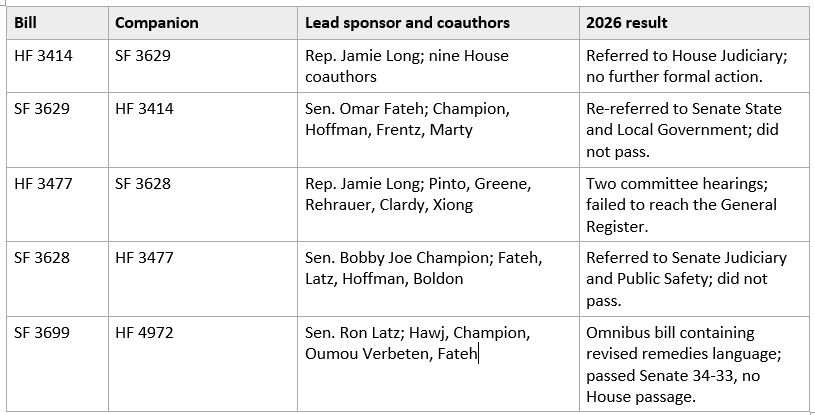
Legislative History
February 17-19: introduction of the standalone bills.
HF 3414, SF 3628, and SF 3629 were introduced on February 17, 2026; HF 3477 was introduced on February 19. Rep. Jamie Long was the lead House author. Sen. Omar Fateh was chief author of SF 3629, and Sen. Bobby Joe Champion was chief author of SF 3628.
February 24: HF 3477 received its first House hearing.
The House Judiciary Finance and Civil Law Committee heard HF 3477. Harrison Stark of the University of Wisconsin Law School, Meagan Forbes of the Institute for Justice, and citizen advocate Roger J. Day testified. The committee adopted the A1 amendment, which removed the entire intergovernmental-collaboration provision. Two other amendments failed. The motion to send the amended bill to the State Government Finance and Policy Committee failed 7-6, leaving the bill without a committee recommendation.
February 25: the full House recalled and re-referred the bill.
The House voted 109-18 to recall HF 3477 from the Judiciary committee and send it to the State Government Finance and Policy Committee. This procedural vote allowed the bill to receive another hearing despite the failed committee motion the previous day.
March 5: the second House committee adopted a further amendment, but the bill again failed to advance.
The State Government Finance and Policy Committee adopted the A4 amendment. It retained the deletion of the collaboration provision and changed the applicability clause so that the new cause of action would cover claims accruing on or after December 1, 2025. The motion to place the amended bill on the General Register, the step required for House floor consideration, failed 6-7. HF 3477 therefore never received a House floor vote.
March 25-May 11: revised language moved through the Senate in SF 3699.
The Senate Judiciary and Public Safety Committee advanced SF 3699, an omnibus immigration-enforcement and civil-remedies bill. Article 5 contained a rewritten version of the Constitutional Remedies Act. After additional floor amendments, the Senate passed SF 3699 on May 11 by a 34-33 vote.
May 18: the biennium ended without House passage.
The House took no recorded action on SF 3699 or its companion, HF 4972, before the 94th Legislature adjourned sine die on May 18, 2026. Because this was the end of the two-year legislative biennium, the proposal cannot simply remain pending. It would have to be introduced again in the 2027-2028 Legislature.
Bill Changes during the Session
The version that passed the Senate preserved the basic cause of action but materially narrowed and clarified several provisions.
Table 2. Bill Changes
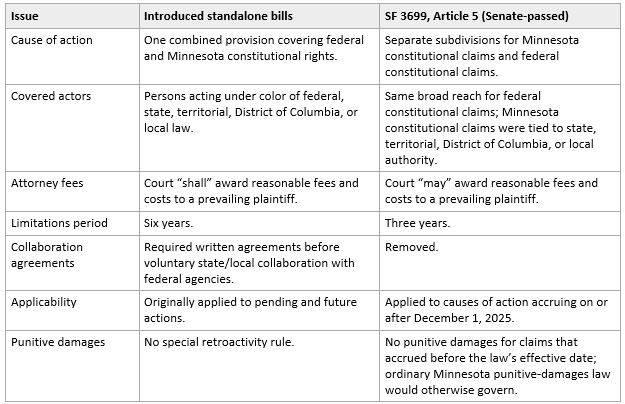
Article 5 of SF 3699 also contained a separate civil remedy related to Minnesota Statutes section 609.662, which requires certain peace officers to investigate and render assistance when another officer uses force. That provision was part of the same omnibus article but was legally distinct from the proposed section 604.51 constitutional cause of action.
How a claim would likely have worked. A plaintiff would have needed to identify a specific federal or state constitutional right, show that the defendant acted through governmental authority, prove that the defendant caused the deprivation, and establish the injury and requested relief. The act would not have created automatic liability whenever a government interaction produced harm. Ordinary requirements concerning pleading, proof, causation, damages, jurisdiction, and available defenses would still matter.
Although the act was state legislation, a claim against a federal officer would likely have been removed from state court to federal court under the federal-officer removal statute. The suit would still arise under Minnesota law, but a federal court would decide the claim and the associated federal defenses. The most plausible form of damages claim would be against an officer personally rather than directly against the United States, because the federal government retains sovereign immunity unless Congress waives it.
Principal Legal Questions
No court ruled on the Minnesota proposal because it never became law. The following issues would likely have been litigated if it had been enacted. They should be understood as unsettled questions rather than resolved defects or guarantees of validity.
1. Federal supremacy and intergovernmental immunity.
Critics argued that Minnesota could not regulate or impose liability on federal officials in a way that interfered with lawful federal functions. Rep. Peggy Scott raised this concern during the House hearing. Supporters answered that the act would not make state policy superior to federal policy; it would supply a remedy for conduct that violates the federal Constitution itself. The removed collaboration-agreement provision presented a more direct state-federal conflict question than the standalone damages remedy.
2. Westfall Act preemption.
The Westfall Act ordinarily makes the Federal Tort Claims Act the exclusive remedy for many state-law tort claims arising from federal employees’ official conduct. It also contains an exception for civil actions brought for a violation of the United States Constitution. Supporters relied on that exception to argue that a state-created constitutional claim is not preempted. At least one federal appellate decision involving New Jersey law has taken a contrary view, so the issue is not settled nationally.
3. Qualified immunity and other official defenses.
The Minnesota bills did not expressly abolish or codify qualified immunity. Defendants would likely have argued that the defense should apply, particularly because the proposal mirrored Section 1983. Plaintiffs could have argued that a state legislature may define the defenses available under a new state cause of action. Courts would have had to decide whether federal or state immunity doctrines applied and whether the answer differed for federal, state, and local defendants.
4. Sovereign immunity and the identity of the defendant.
The text imposed liability on a “person,” language modeled on Section 1983. It did not expressly waive the sovereign immunity of the United States, Minnesota, or another government. Claims for damages would therefore likely focus on individual officers, while claims seeking prospective injunctive relief could involve different official-capacity rules. The lack of explicit capacity language would have generated litigation over the statute’s precise reach.
5. Overlap with existing remedies.
For state and local officials accused of violating federal rights, plaintiffs already may use Section 1983. The Minnesota act would have added a parallel state cause of action. Courts would need to address claim duplication, damages, fee recovery, and preclusion. For violations of the Minnesota Constitution, the new state claim would have served a more distinct function because Section 1983 does not enforce state-only constitutional rights.
5. Retroactivity.
The A4 amendment and SF 3699 applied the new cause of action to claims accruing on or after December 1, 2025, even though the proposed law would have taken effect later. Retroactive civil liability can raise due-process and statutory-construction questions. The Senate version attempted to reduce one concern by prohibiting punitive damages for claims that accrued before enactment.
Support and Criticism
A legislative supporters’ one-page document identified the ACLU of Minnesota, the Institute for Justice, the Justice Action Network, and the Minnesota Justice Research Center. The committee record also contains supporting submissions from SEIU Local 26 and North STAR Alliance. Supporters emphasized that government authority should be accompanied by a meaningful remedy, that the federal-officer accountability gap has widened as Bivens has narrowed, and that the bill applied across levels of government rather than singling out only one agency.
The House committee record does not identify a comparable organizational opposition coalition for HF 3477. Opposition in the hearings came principally from legislators who questioned the proposal’s constitutionality and practical consequences. The main concerns were potential conflict with federal supremacy, expensive litigation funded by taxpayers, uncertainty about immunity, retroactive liability, and duplication of existing Section 1983 remedies for state and local officers. The repeated close committee votes and the 34-33 Senate vote show that the proposal remained politically contested.
Similar legislation in other states. As of August 2026, ten states have enacted statutes providing, or potentially providing, a state-law civil remedy against federal officials for constitutional violations: California, Maine, Massachusetts, New Jersey, Illinois, New York, Vermont, Maryland, Connecticut, and Rhode Island.
California, Maine, Massachusetts, and New Jersey rely on older, generally worded civil-rights statutes whose application to federal officials has been subject to legal debate. The remaining six states have enacted more explicit modern statutory remedies addressing constitutional violations involving federal officials.
Comparable measures were introduced in roughly a dozen states in 2026. Washington’s HB 2597 cleared its policy and appropriations committees but remained in House Rules, and Colorado’s SB 26-005 passed both chambers but was vetoed on June 3, 2026. No other states have enacted a comparable remedy as of July 26, 2026.
- Illinois: Enacted the Illinois Bivens Act (Public Act 104-0440), effective January 1, 2026. It creates a cause of action for constitutional violations committed in connection with civil immigration enforcement and expressly preserves qualified immunity as a defense.
- Vermont: Enacted H.849 as Act 87 in 2026. The law expressly creates a civil action for damages for deprivation of federal constitutional rights by a government official.
- New York: Enacted the New York State Bivens Act in 2026. Now codified in Article 8-A of the New York Civil Rights Law, it creates a cause of action against persons acting under color of federal, state, territorial, District of Columbia, or local law for deprivation of rights secured by the U.S. Constitution.
- Maryland: Enacted the No Kings Act, SB 346/HB 351, as Chapters 460 and 459 in May 2026. The law establishes civil liability for persons acting under color of law who deprive another person of rights, privileges, or immunities secured by the U.S. Constitution or federal law. The law takes effect October 1, 2026.
- Connecticut: Enacted Public Act 26-14 in 2026. Among its provisions, the law establishes state remedies and restrictions concerning specified unlawful law-enforcement conduct, including conduct by federal law-enforcement officers.
- Rhode Island: Enacted the Rhode Island Federal Constitution Defense Act in 2026. The law creates an express state cause of action allowing individuals to sue federal officials for violations of federal constitutional rights and took effect upon passage.
The statutes vary substantially in scope, available defenses and remedies, and whether they apply generally to constitutional violations by government officials or focus more narrowly on particular enforcement contexts, especially federal immigration enforcement.
Current Status
As of July 26, 2026, Minnesota has not enacted the Constitutional Remedies Act. HF 3414, HF 3477, SF 3628, and SF 3629 all ended the biennium without passage. SF 3699 passed the Senate but not the House and was not enacted. No new Minnesota Statutes section 604.51 was created. Any effort to enact the proposal must begin again with new legislation in the 95th Legislature, which is scheduled to convene on January 12, 2027.
This page was written by Alex Bagdade, July 2026.